


Campus Sustainability Council

Mission Statement
The role of the Campus Sustainability Council (CSC) is to provide funding to registered student organizations at the University of California at Santa Cruz (UCSC) for programs and events that create, implement, and monitor environmentally sound practices on campus as established through the protocol outlined in the Blueprint for a Sustainable Campus. These organizations additionally facilitate greater collaboration between students, the administration, staff, faculty, and the community. The goal of the CSC is to increase sustainability on the UC campus while fostering a beneficial learning experience for students in writing grants and implementing ideas into projects.

Our Story
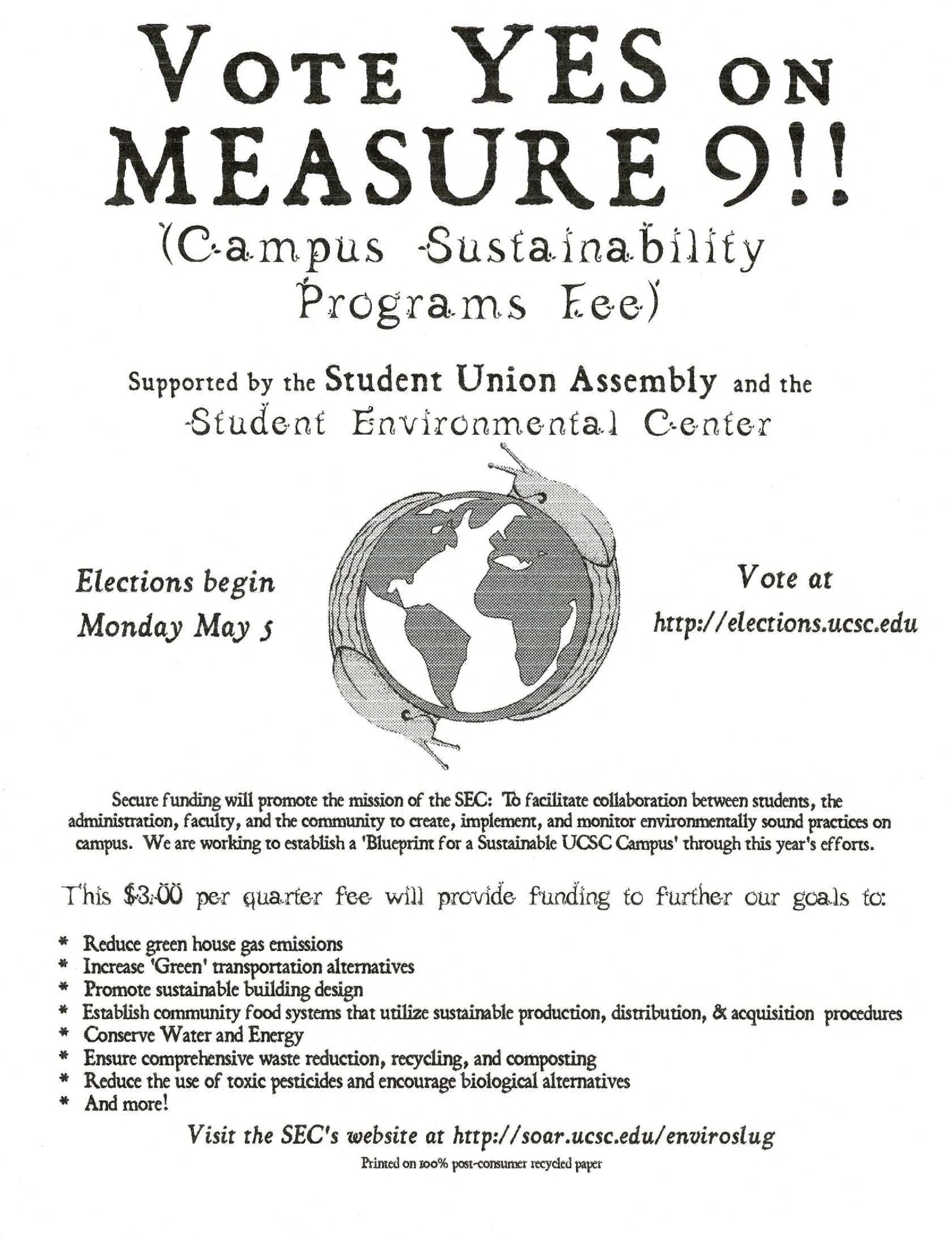
In the Spring of 2003, the Student Environmental Center (SEC) led the campaign to get Measure 9, the Campus Sustainability Programs Fee, passed.
This ballot measure created the Campus Sustainability Council (CSC) ensuring the institutionalization and long term viability of student-initiated efforts towards campus sustainability funded through a $3 per quarter fee paid by every undergraduate student.
In the Spring of 2005, students campaigned again and won Measure 14 which added an additional $3 per quarter fee, bringing the total allocation to campus sustainability movements to $6 per quarter, per student.

Select the process (A or B) that fits your proposal idea (see below).Read the requirements, guidelines, and application of the process you selected.Research your budget and answers to all application questions.Contact CSC if you have questions. We advise you to contact us before April 24th 2026 at csc@ucsc.edu so you have time to make adjustments.Submit your completed application by the deadline, Wednesday April 28th 2026. Submissions by this form only.Respond to emails from CSC within 24 hours between April 29th and May 30th, to answer any questions council members have.Receive CSC decisions by June 12th 2026.
Application Process
NOTE: Applications for FY27 Process A&B closed on April 26 2026.
Important Documents & Forms
Applicant Qualifications
The Campus Sustainability Council shall only fund a group of students registered under SOAR, Student Media, OPERS, a college, or a department. Additional groups may be funded on a case-by-case basis at the present council’s discretion. The CSC shall define a registered student organization as a group of students that meet the following:

A group of a minimum of four undergraduate students that demonstrate a high level of governance over their project implementation,
A clear internal structure of meeting times and locations, student positions, and responsibilities for the organization's membership regarding campus fiscal procedures,
Regular meetings sufficient to facilitate informed member participation in decisions,
A UCSC unit that agrees to serve as the sponsor and administrator of the organization's funds that understands and is accountable to the responsibilities of the position,
An updated document on file with the sponsoring unit that describes clear goals and objectives for the organization, its membership, decision-making processes, amendments, and the election/selection procedures of authorized representatives,
Students must remain the primary source of innovation, direction, and implementation of all projects.
Relevancy to the Blueprint for a Sustainable Campus
This discretionary funding is possible under the language of the ballot measure, specifically: “The CSC shall have full and sole decision-making power over all funding allocation and programming decisions so long as those decisions are consistent with SUA and University policy and the law.”
CSC Funding Guide: Choosing Between Process A & Process B
Process A – Small Projects / Events
Purpose:
Supports one-time events or smaller, time-limited initiatives.
Examples:
Hosting a speaker
Supplies and/or services to ensure zero waste at an event
Educational activity or performance
Purchase of educational materials or displays
Budget Limitations:
Requested budget must be under $5,000.
Total project budget may exceed $5,000.
Process A Guidelines:
Guideline A (Evaluation) - If you are a returning applicant, you must complete a CSC Evaluation Form for your most recent CSC grant before or at the same time as submitting your new application.
Guideline B (Diversity) - Projects that address and demonstrate inclusion of a diversity of experiences and perspectives will be given priority.
Guideline C (Sustainability) - Projects that address sustainability or relevance to environmental justice will be given priority.
Guideline D (RSO & UCSC Students)- The applicant must be a registered UCSC student organization that: 1) has at least 1 year of experience producing projects or programs at UCSC; 2) consists of enrolled undergraduate students when the proposal is submitted and during the time the funds are used.
Guideline E (Collective Experience & People Power) - The applicant must demonstrate the collective experience and people power needed to complete the project proposed.
Guideline F (Project Budget) - Budgets must include clearly itemized, research-based costs, demonstrate cost-effectiveness, and incorporate sustainable and environmentally responsible items that minimize environmental impact.
Guideline G (Approved Funds) - Funds must be spent in strict accordance with the budget submitted and approved by CSC.
Guideline H (Fiscal Sponsor) - A campus office and university financial staff person must agree to provide the necessary administrative support.
Guideline I (Campus Policy) - Projects must be within campus policy and the requirements of registered student organizations.
Guideline J (Travel) - Travel costs to conference will be given a lower priority because the number of students directly benefiting is generally smaller. Proposals must describe how the travel will benefit the larger campus community.
Guideline K (International Work) - Any project with an international focus must show its relevance to domestic groups.
Process A Restrictions: Projects and expenses not funded by CSC include,
Projects initiated or implemented by campus units, staff, or faculty.
Off-campus events and/or projects that will benefit primarily off-campus groups or audiences.
Fees such as: enrollment fees, EAP costs, salaries or stipends, living expenses, or funds to support senior thesis projects.
Gifts, mementos, awards, and plaques are not funded by CSC, in accordance with campus accounting procedures and Divisional funding priorities. Some examples of gifts include but are not limited to are sweaters, graduation stoles, senior roses, etc.
Expenses that have already occurred. Proposals for programs that have already taken place will not be considered.
Projects or expenses for alterations to campus buildings or grounds.
Paid Student Internships/Positions.
Funds will not be provided if they are to be given or transferred to another source; sponsors must apply for funds directly. If an event is to be co-sponsored by multiple student organizations, a proposal must be co-authored.
Events approved under Process B are not eligible for funding through Process A within the same academic year.
NOTE: Funds must be spent in strict accordance with the budget submitted to and approved by CSC. Applicants must obtain approval from the committee prior to expenditure of funds for items/services not included in the original budget
Process B – Large Events or Ongoing Projects
Purpose:
Supports larger projects or ongoing services, resources, or operations.
Examples: (in addition to Process A)
Internships or paid roles for sustainability work
Campus services or programs operating across quarters
Budget Range:
Requested budget over $5,000
Process B Guidelines:
Guidelines A - K (Process A)
Guideline L (Alterations of Campus Grounds or Buildings) - Any project that proposes changes to campus grounds or buildings must be directly related to the project’s purpose. Applicants must also provide written confirmation of approval from the staff member responsible for overseeing the affected area.
Guideline M (Paid Student Internships/Positions) - Proposals that include paid student roles must clearly outline the pay rate, expected weekly hours, and method of payment. They must also describe the process for recruiting, training, and evaluating each position. Complete job descriptions for all roles must be included as attachments.
Process B Restrictions: Projects and expenses not funded by CSC include,
Projects initiated or implemented by campus units, staff, or faculty.
Off-campus events and/or projects that will benefit primarily off-campus groups or audiences.
Fees such as: enrollment fees, EAP costs, salaries or stipends, living expenses, or funds to support senior thesis projects.
Gifts, mementos, awards, and plaques are not funded by CSC, in accordance with campus accounting procedures and Divisional funding priorities. Some examples of gifts include but are not limited to are sweaters, graduation stoles, senior roses, etc.
Expenses that have already occurred. Proposals for programs that have already taken place will not be considered.
Funds will not be provided if they are to be given or transferred to another source; sponsors must apply for funds directly. If an event is to be co-sponsored by multiple student organizations, a proposal must be co-authored.
Events approved under Process B are not eligible for funding through Process A within the same academic year.
NOTE: Funds must be spent in strict accordance with the budget submitted to and approved by CSC. Applicants must obtain approval from the committee prior to expenditure of funds for items/services not included in the original budget
Blueprint for a Sustainable Campus
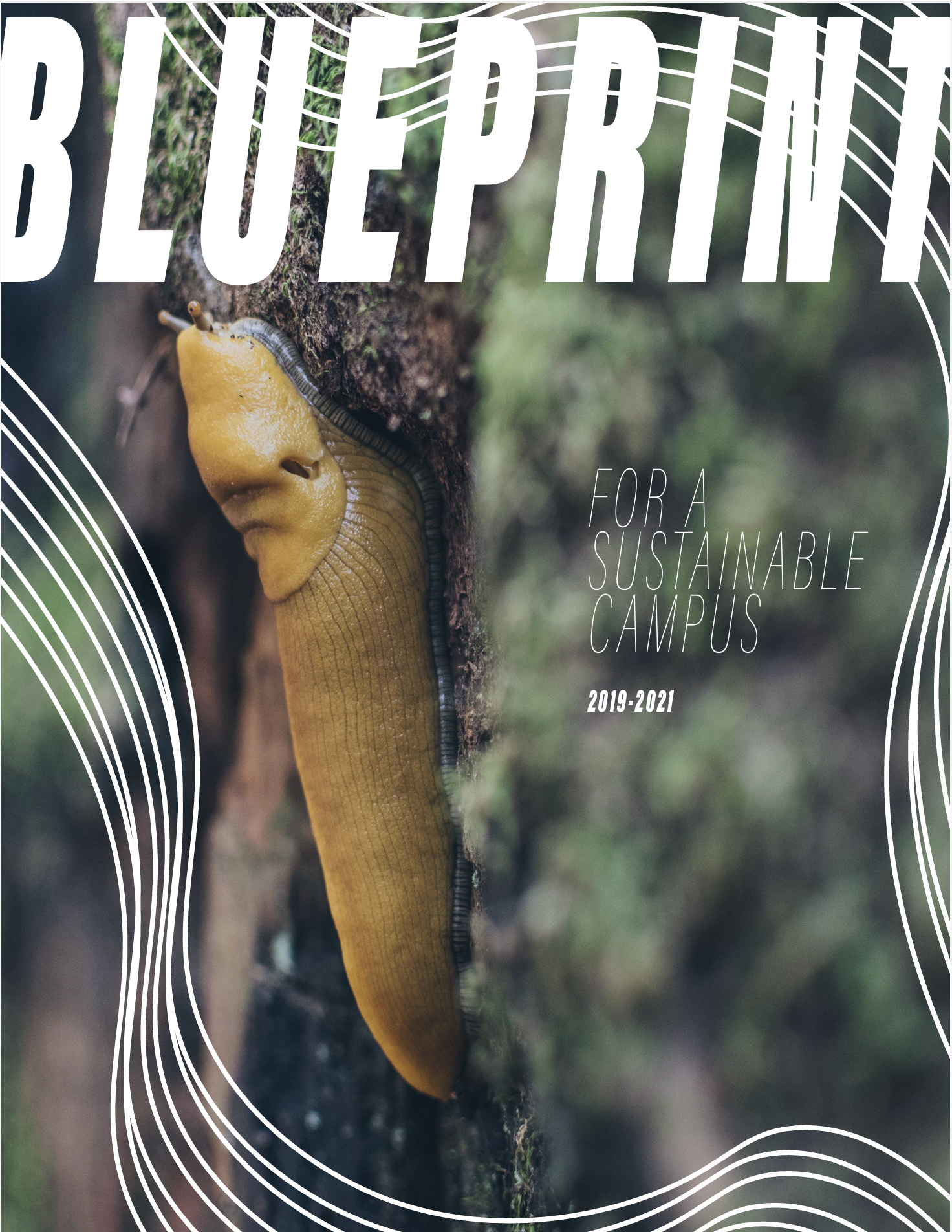
The Blueprint for a Sustainable Campus is a multi-use, living document that strives to encompass the current visions of students, faculty, staff, and community members that have come together to share their ideas and goals for the future of UCSC at the annual Campus Earth Summit event. This document is meant to serve as a launching point for students to create meaningful, collaborative projects on campus that inspire lasting change. The Blueprint also acts as a guide for student organizations interested in receiving funding from the Campus Sustainability Council for the upcoming school year. While the Blueprint reflects no commitments from the administration, the process through which it is compiled displays multiple points of collaboration throughout the campus and community.

Zero Waste Event Guide
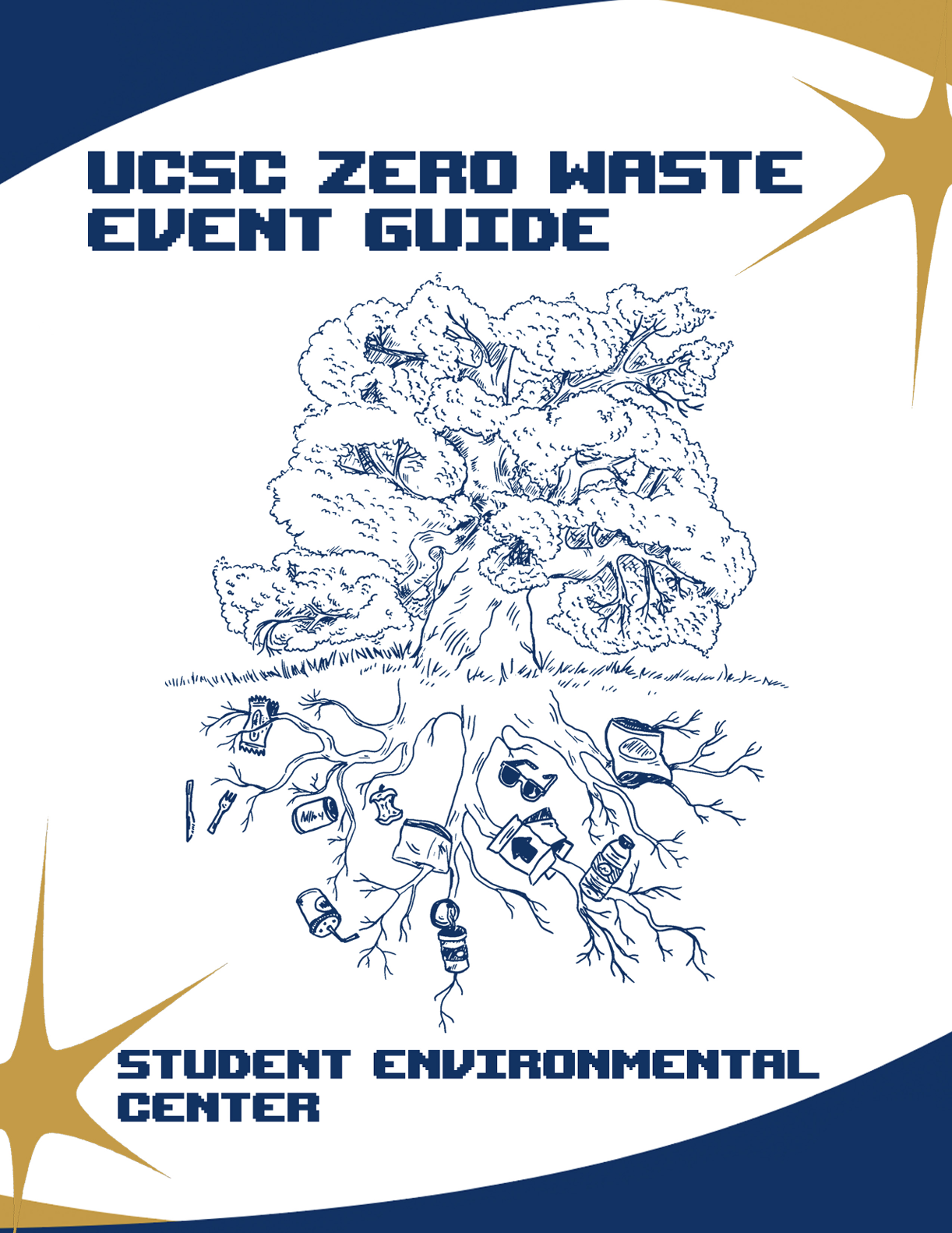
The Student Environmental Center (SEC) created this Zero-Waste Event Planning Guide as a resource for all UC Santa Cruz students to host events that fulfill the needs of our community while also being conscious of our current waste crisis . Though UCSC has been attempting to reach their goals of being zero-waste since 2004, they have a long way to go, currently ranking ninth out of all ten UCs in the amount of waste they divert from the landfill . Now, more than ever, students are working towards making their events as sustainable as possible in order to ensure a zero-waste future at UCSC .
This guide breaks down the resources needed to create zero waste events into three parts: before the event, during the event, and after the event . Each part will detail different steps to take and resources to explore when planning the event . Keep in mind that this is a guide, not every step may be applicable or feasible in every event, but whatever steps students are able to take in reducing their waste is a step toward a more environmentally conscious campus .
-
Student groups eligible for funding by the Campus Sustainability Council (CSC) must be registered under SOAR, Student Media, OPERS, a college, or a department. Additionally, the CSC may fund other groups on a case-by-case basis at their discretion.
-
Apply under Process A if your project is a small, one-time event or educational activity under $5,000.
Apply under Process B if your project is large-scale, ongoing, involves paid positions, or exceeds $5,000.
Both require strong alignment with CSC’s goals of student leadership, innovation, sustainability, and inclusion, as well as compliance with UCSC policies and financial oversight.
Most importantly, students must be the main drivers of innovation and implementation.
-
Review the Updated Application: The CSC grant application process has been updated, so even if you’ve applied in previous years, you should carefully review the new guidelines and requirements.
Prepare Your Application: Submit your grant application by the deadline via the Google Form. Be sure to include all required information, such as your project proposal, budget, timeline, and how your project aligns with CSC values.
Ensure Eligibility: Make sure your group is either:
Registered under SOAR, Student Media, OPERS, a college, or a department,
ORMeets CSC’s definition of a registered student organization and obtains discretionary approval if you're outside those listed units.
Evaluation Requirement: If you’re a recurring applicant and have previously received CSC funding, you must complete a project evaluation at the end of your funded project or by the end of the academic year. This evaluation helps demonstrate accountability and shares important insights with the campus sustainability community.
Questions?: If anything is unclear or you need help, you’re encouraged to reach out to the CSC at csc2003@ucsc.edu.
